Echolight
A stereo delay that dissolves into a cloud. One knob takes it from clean repeats on the beat, through a smear, to a shimmering reverb the echoes feed, with colour that builds on every repeat, echoes that bounce and orbit, a filter that moves with the tempo and your playing, and a tape stop.
A delay that turns into a cloud
An echo is a copy of what you played, arriving later and a little quieter. A reverb is the same idea taken to its end: so many copies, so close together, that they stop being copies and become a space. Most plugins put the two on either side of a switch. Echolight puts them at either end of one knob.
With Diffusion at zero it is a clean, honest delay: repeats on the beat, each a little darker than the last, and not a trace of the cloud computed. Turn it up and a wash grows around the repeats until they melt into it; keep going and only the cloud they feed is left, with the grains from Ghostlight Pro sparkling on top.
The same clip, dry and wet
8 sources, each run through the factory preset built for it. Toggle Dry/Wet mid-playback — it crossfades from the same instant rather than restarting.
One knob from delay to reverb
Diffusion blends the raw repeats, a smear of them and a cloud they feed. Dissolve sets exactly where on its travel the repeats vanish, so the knob can stay a delay for most of its range or melt early into a wash.
Colour that builds on every repeat
Tone, Low Cut, Warm, Clipper, Wow and Flutter sit inside the loop, so the first echo is shaped once and the fifth five times, the way a tape echo's repeats wear with every pass.
Echoes that move
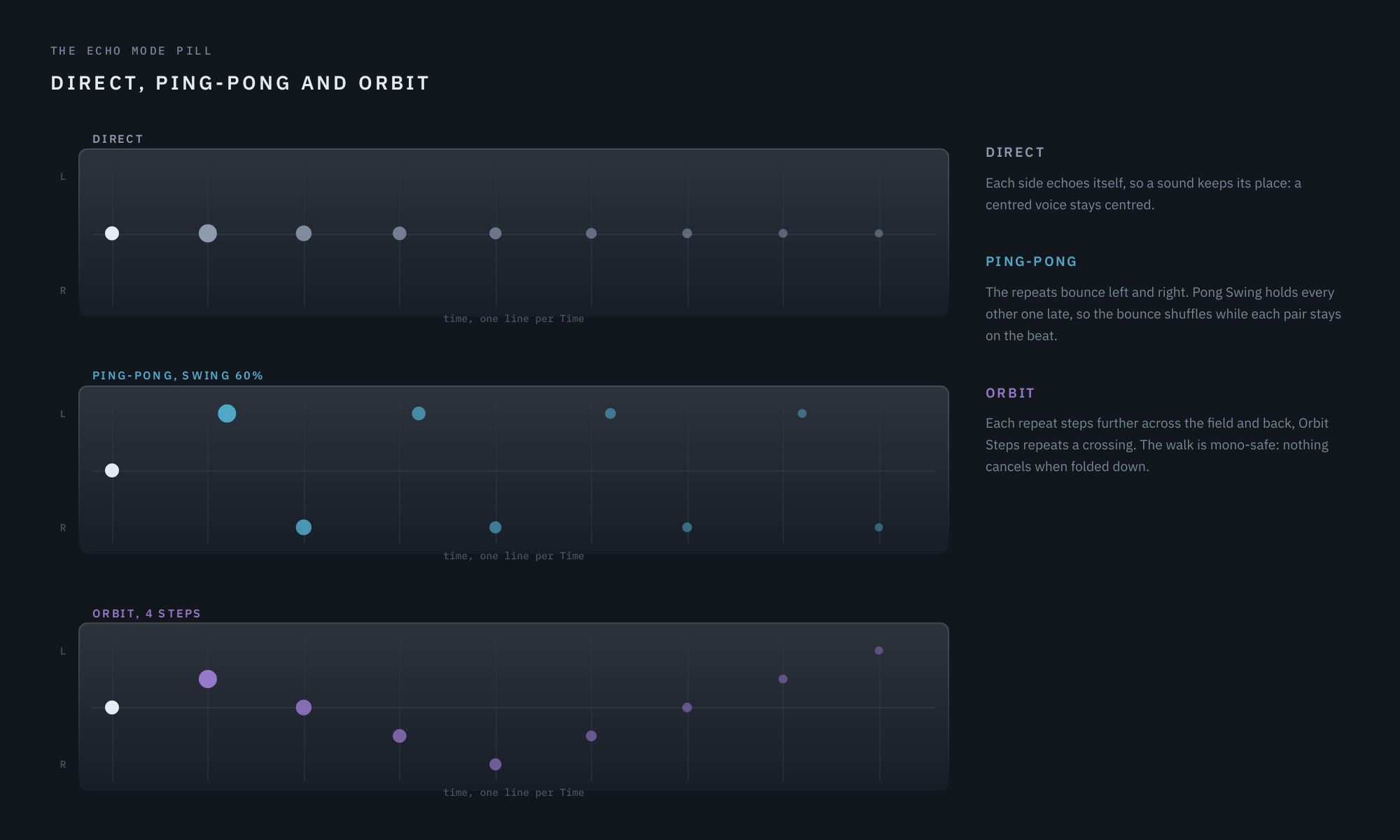
Direct keeps a sound where it is; Ping-Pong bounces the repeats, with a swing that shuffles every other one; Orbit walks each repeat a step further across the field, and stays mono-safe.
A filter page that moves
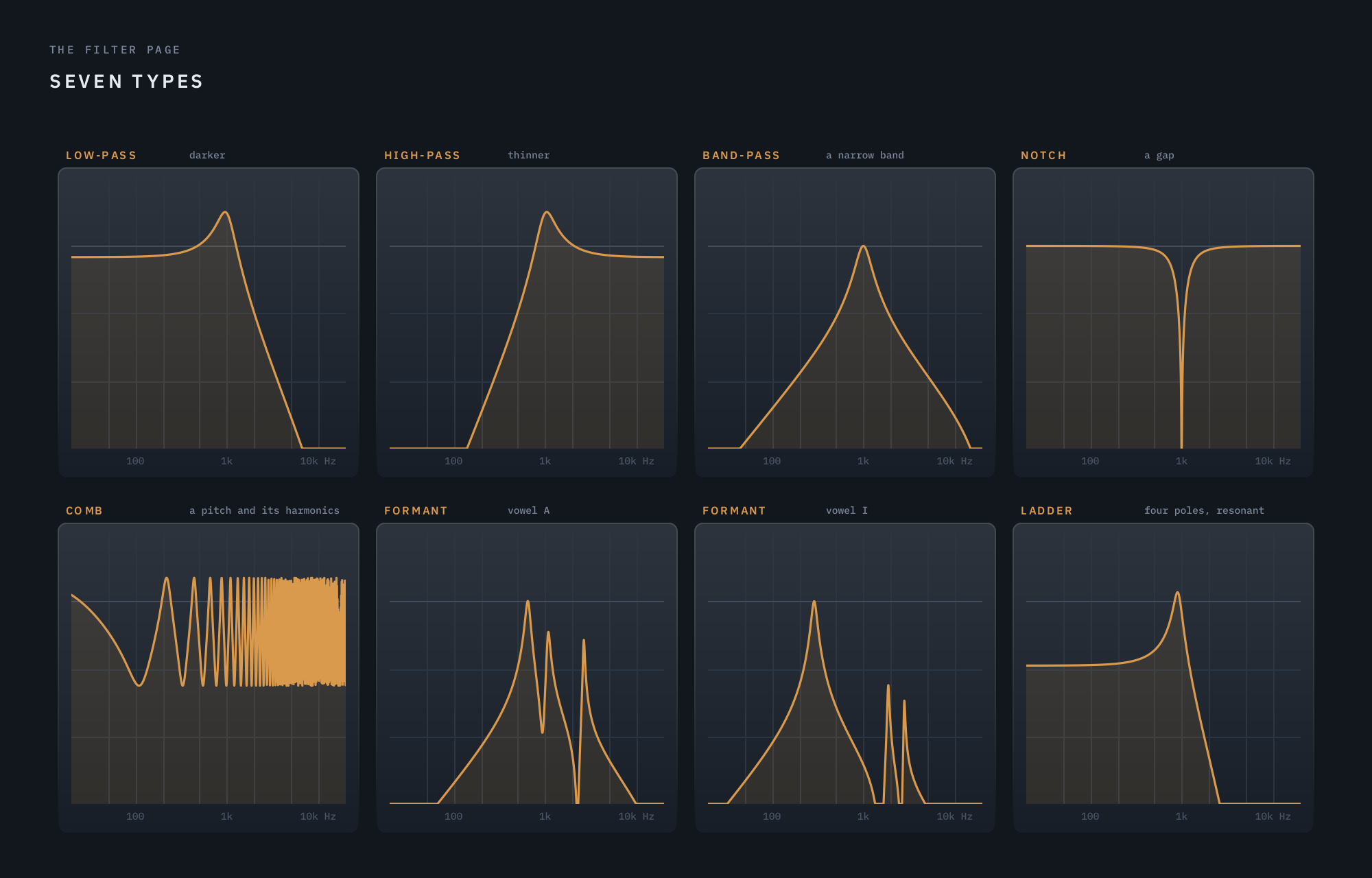
Low-pass, high-pass, band-pass, notch, comb, formant and ladder, after the loop or inside it, moved by an LFO locked to your song and by an envelope following your playing.
Nothing runs away
Feedback stops at 100%, everything that could lift a frequency sits outside the loop, and the filter never boosts anything while it is inside it. Two safety ceilings with no knob do the rest.
Tape where it counts
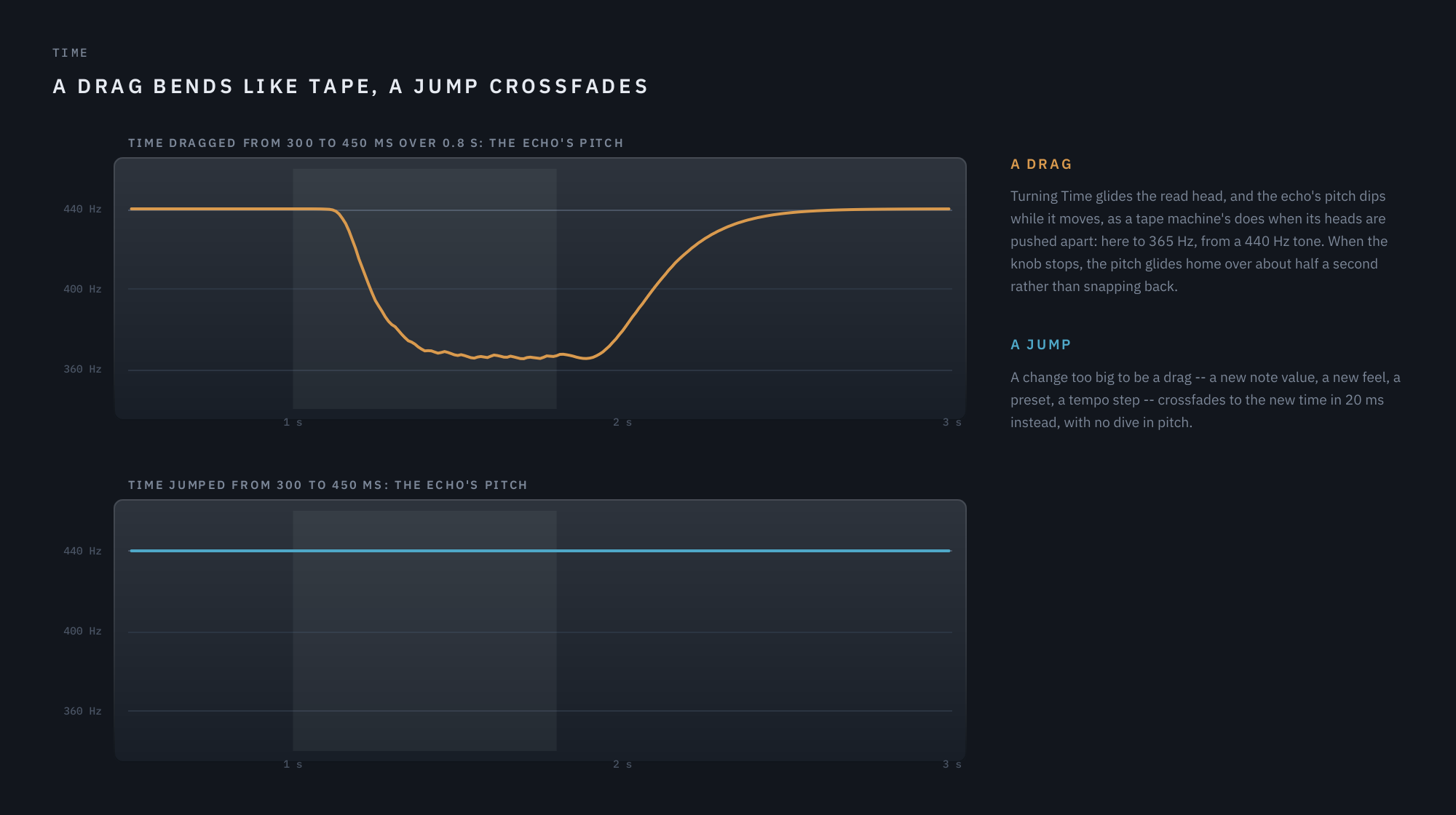
Dragging Time bends the pitch as a tape delay does; a new note value crossfades instead. Hold Stop and the echoes wind down to a halt and spin back up when you let go.
Grains from Ghostlight Pro
Scatter, Grain, Shimmer, Tune, Air and Link work on the cloud, not on each echo, so Shimmer is a sparkling haze over a tail, and Link bursts the grains on every new note.
Echoes that make room
Ducking listens to what you play and pulls the echoes, the cloud and the grains down while you play, letting them swell back in the gaps.
Off means off
Every shaping control has a setting where it is not computed at all. At its defaults Echolight is a plain delay, to the bit, with zero latency.
One knob from delay to cloud
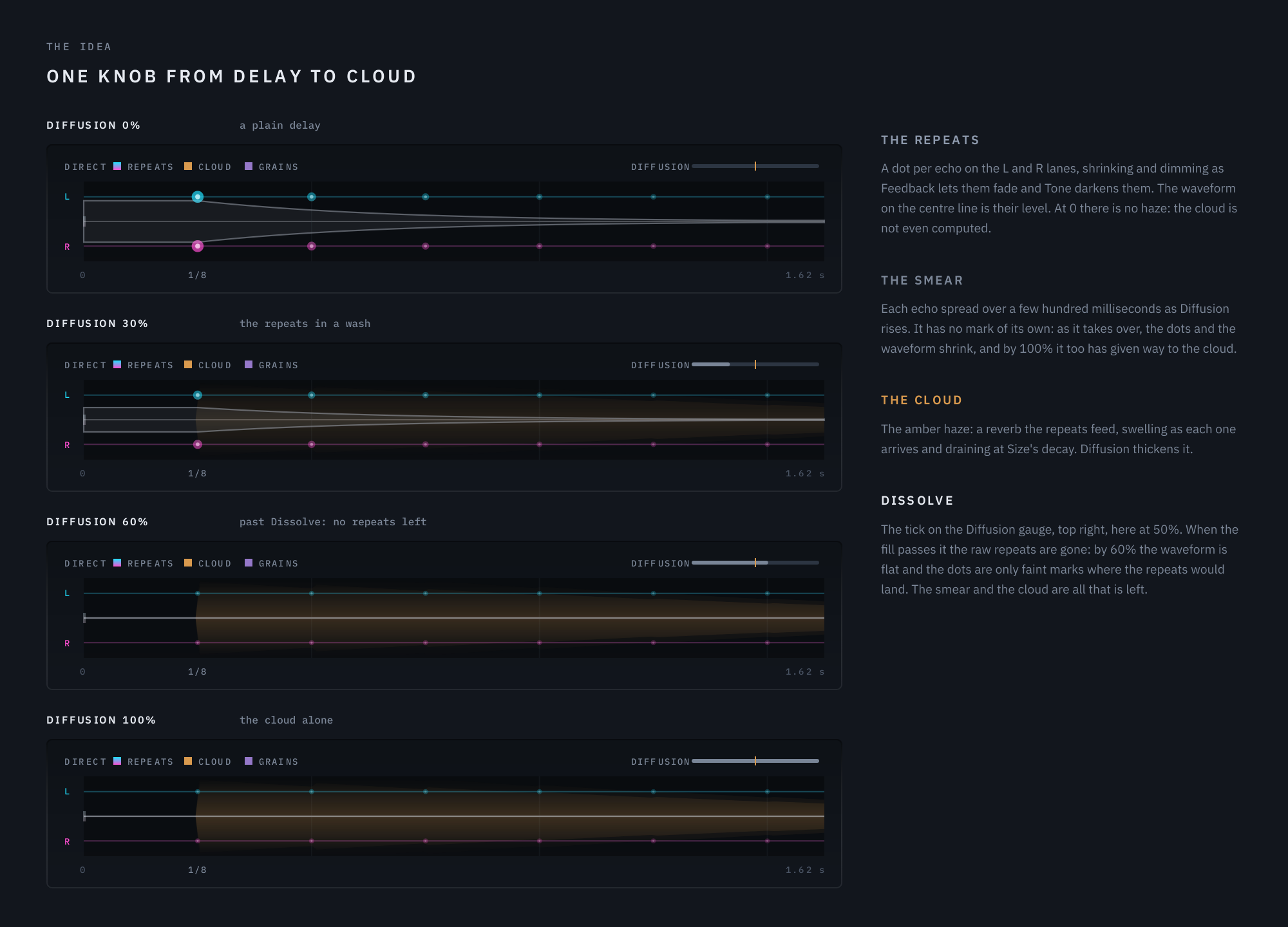
Diffusion blends three things: the raw repeats, a smeared version of them, and a cloud fed by the repeats. At 0 only the raw repeats sound. As it rises they give way to the smear and the cloud, and at the top only the cloud is left.
A raw echo left in the mix keeps its attack: even 12 dB under the cloud it still strikes again each time it arrives. So the repeats only stop reading as repeats once they are completely gone, and Dissolve decides where on Diffusion's travel that happens. The illustrations here, like the ones in the user guide, are computed from Echolight's own code, so each one is exactly what the plugin does.
Inside the loop, every repeat is changed again
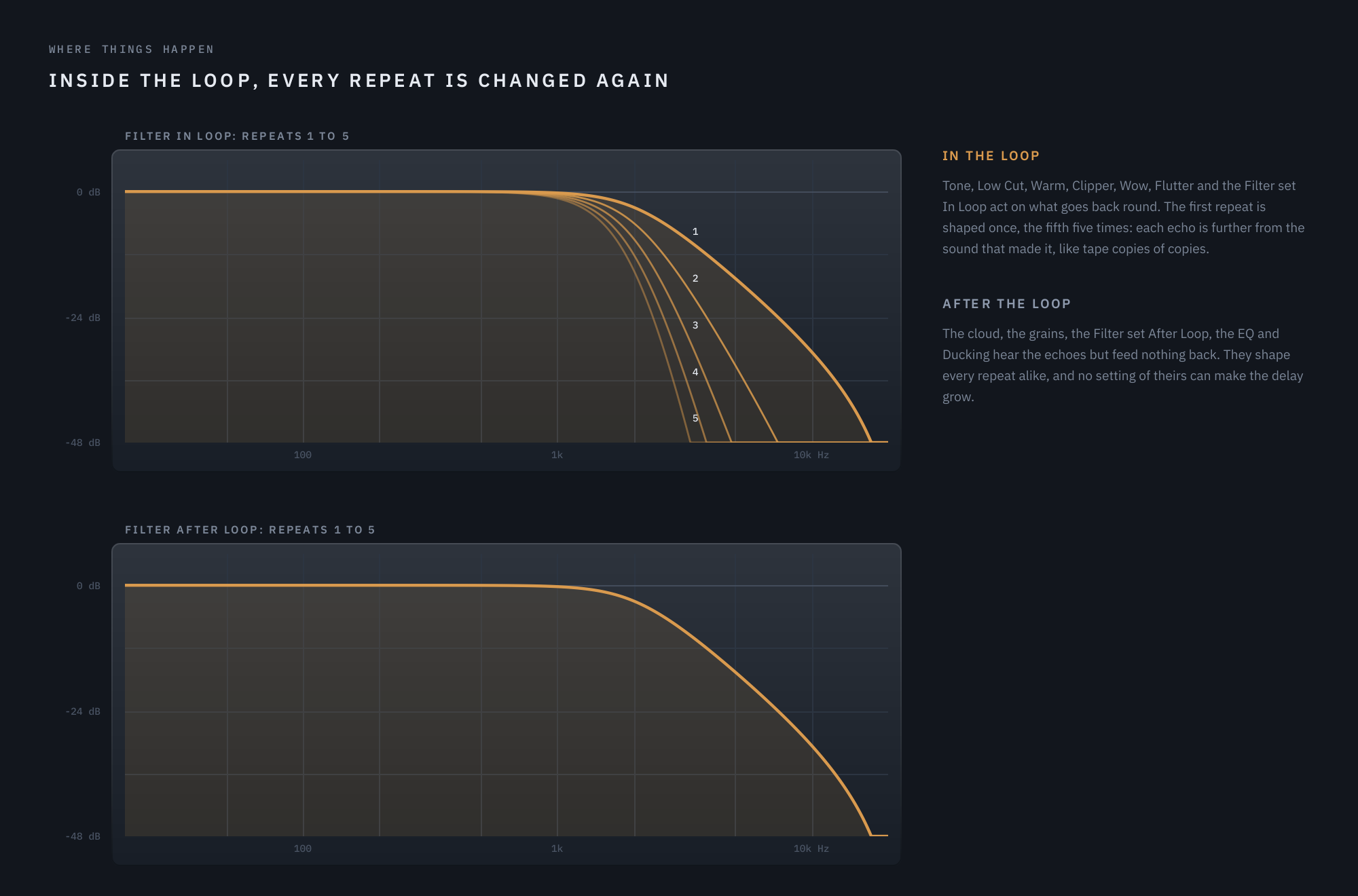
A delay is a loop: what comes out goes back in. Anything inside the loop acts on every repeat again, so its effect compounds; anything after it hears the echoes but feeds nothing back. Echolight uses both on purpose. Tone, Low Cut, Warm, Clipper, Wow and Flutter build character pass by pass, while the cloud, the grains, the EQ and Ducking shape the whole wet sound without changing how many repeats there are or where they land. The Filter page lets you choose: In Loop, a low-pass darkens each repeat further than the last; After Loop, it shapes them all alike.
In the loop, the filter never lifts anything
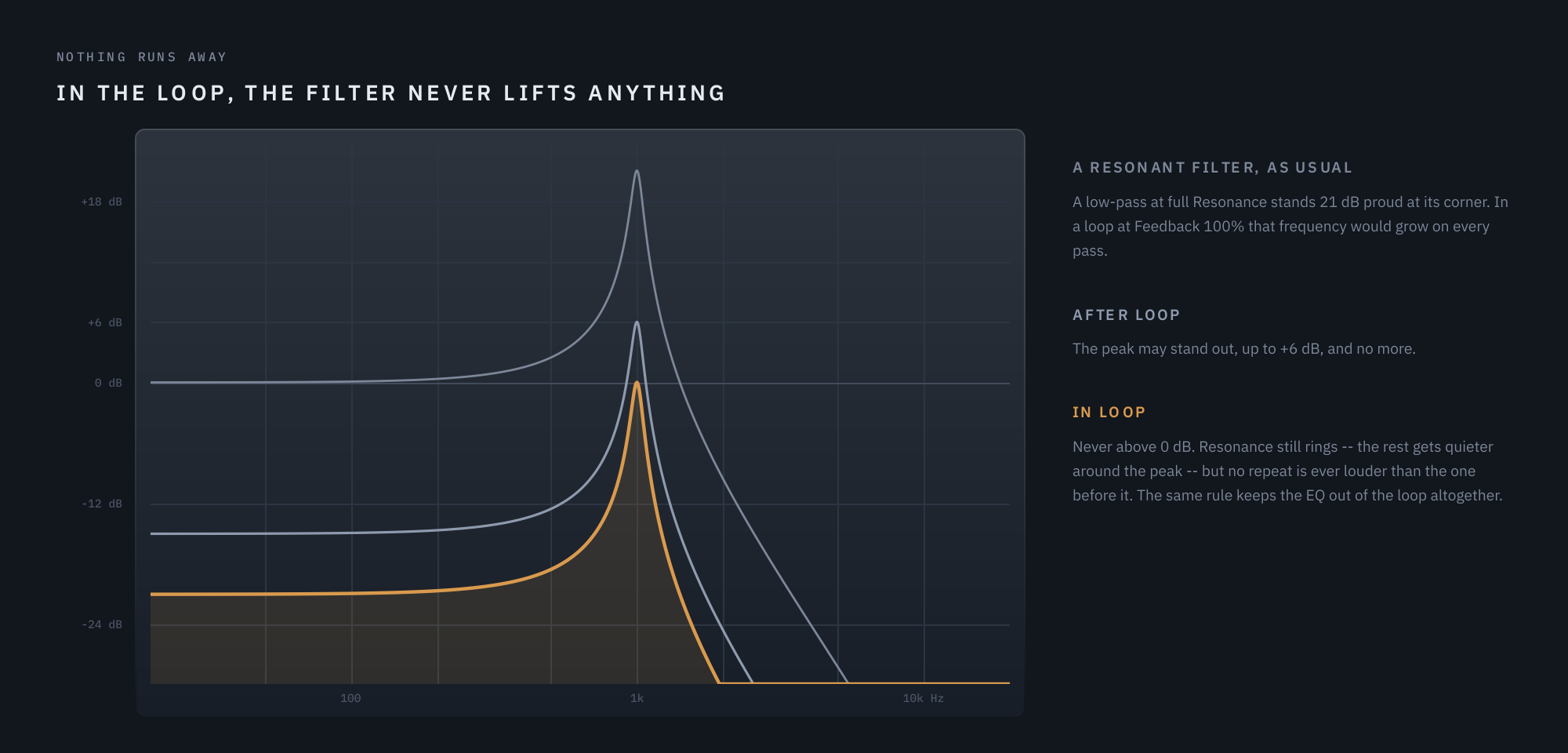
A resonant filter normally stands well above 0 dB at its corner, and in a loop at Feedback 100% that frequency would grow on every pass. Echolight scales every filter type by its exact peak, so In Loop its highest point is 0 dB: resonance still rings, but no repeat is ever louder than the one before. After the loop a peak may stand up to 6 dB proud, and no more. The same rule keeps the EQ out of the loop altogether.
Direct, Ping-Pong and Orbit
One pill in the Delay section's title row cycles where the echoes go. Direct keeps each side echoing itself, so a centred voice stays centred. Ping-Pong bounces the repeats left and right, and Pong Swing holds every other one late, so the bounce shuffles while each pair stays on the beat. Orbit walks each repeat a step further across the field and back, a crossing every few repeats, without anything cancelling when the mix is folded to mono.
Moved by the tempo and by your playing
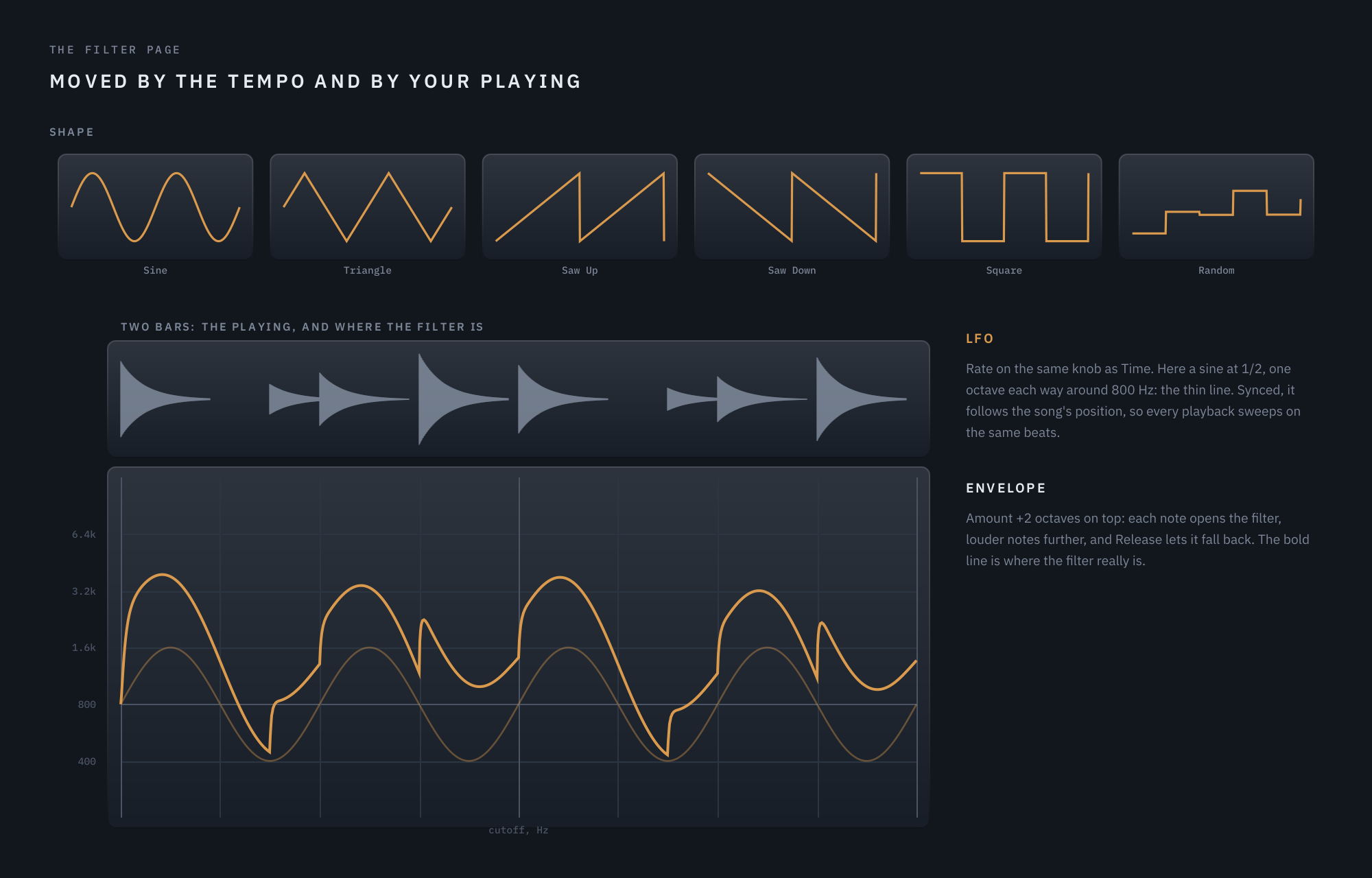
The Filter page's LFO uses the same feel-and-rate knob as Time and, while the song plays, follows the song's position, so a sweep lands on the same beat every playback. Six shapes, from a smooth sine to a random step that repeats the same way each time, and Spread to send the movement across the stereo field.
An envelope listens to your dry playing, never to the echoes, and opens or closes the filter as you play harder. The two add together, and the display draws the filter's real curve moving as you hear it.
A drag bends like tape, a jump crossfades
Turning Time glides the read head, and the echo's pitch dips while it moves, as a tape machine's does. A change too big to be a drag, a new note value, a new feel, a preset or a tempo step, crossfades to the new time in 20 ms instead, so going from an eighth to a quarter note never dives. Wow and Flutter drift the repeats irregularly, left and right independently, and Stop winds the echoes down to a halt and back.
A display that shows the echoes
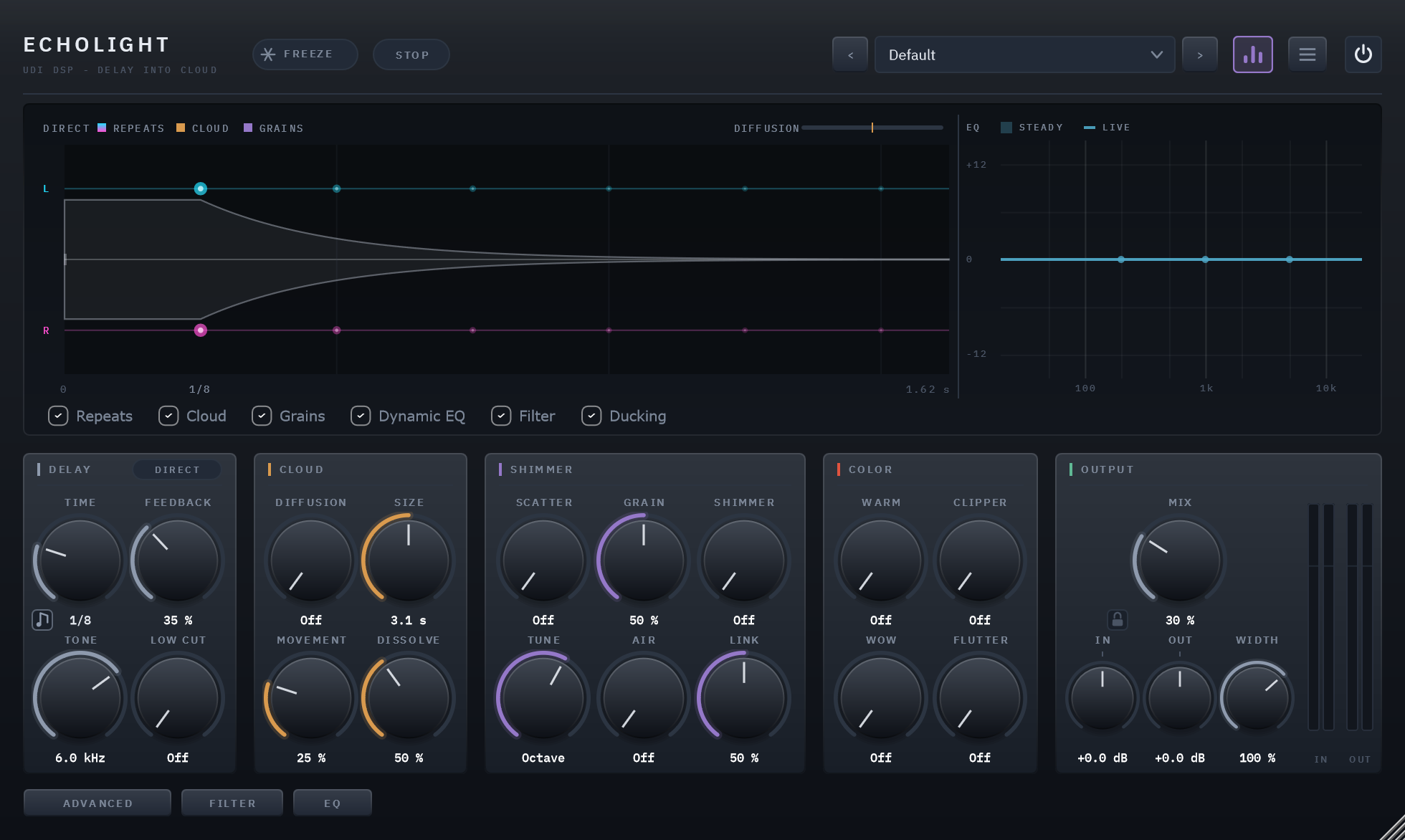
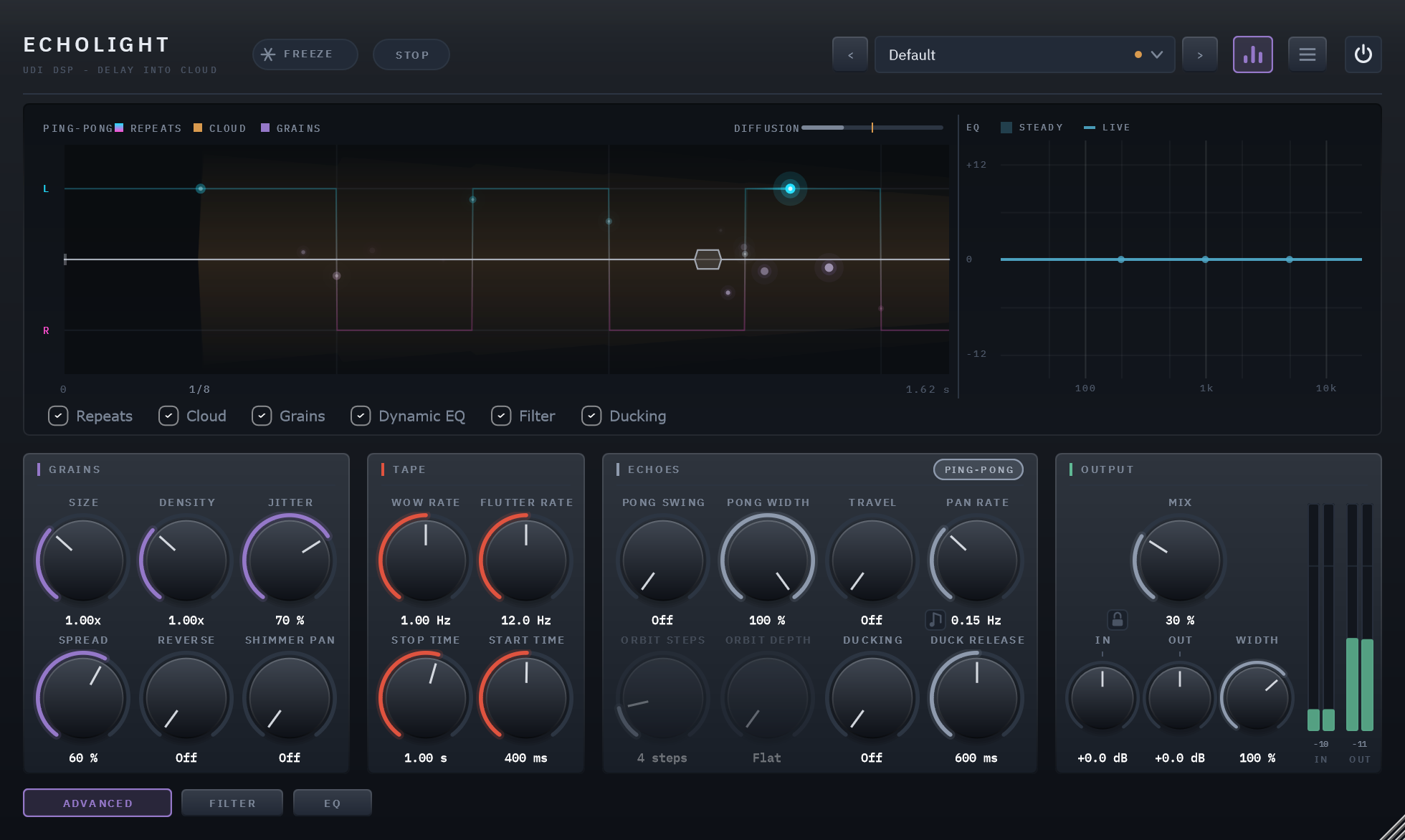
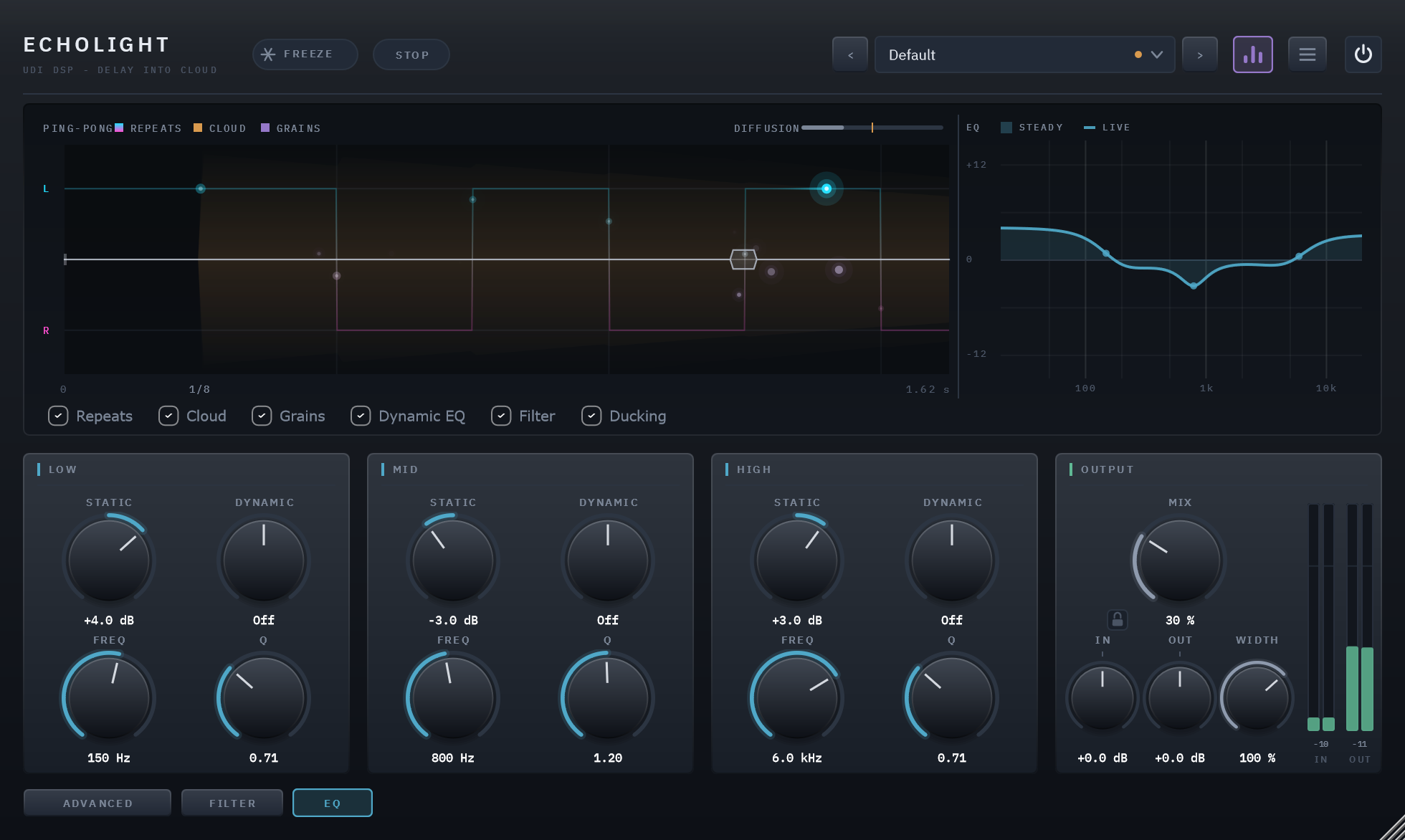
The display is a scope. Time runs left to right: a note is played at the left edge and its echoes travel out to the right, fading as they go. Up and down is the stereo field, L at the top and R at the bottom. One waveform on the centre line is the echoes' level; the dots are the repeats, each coloured by where it sits, cyan at hard left, near-white in the middle, magenta at hard right, and the bright one is where the sound is now. The line through them is the pan the engine is applying, so Direct draws two flat lanes, Ping-Pong a staircase and Orbit a sweep.
The pattern worked out from the knobs is always there, drawn faint, so a preset reads at a glance with nothing playing; as you play, the notes light their own echoes. The amber haze is the cloud, a gauge marks where Dissolve takes the repeats away, purple sparks are grains, and Ducking's pull shows in dB. A strip at the right draws the dynamic EQ's curve, steady and live, and the Filter page's curve beside it, both calculated from the same code the audio runs through. Checkboxes along the bottom take any layer away, and the whole display folds away from the header button.
Eighteen more controls, out of the way until you want them
The Advanced button at the bottom left swaps the main sections for three more. Grains holds the grain settings from Ghostlight Pro: Size, Density, Jitter, Spread, Reverse and Shimmer Pan. Tape holds the machine's speeds and ramps: Wow Rate, Flutter Rate, and Stop's two times. Echoes holds what the repeats do: Pong Swing and Pong Width, how Ping-Pong shuffles and how far apart its sides sit; Travel, which walks its repeats across the field instead of jumping; Orbit Steps, and Orbit Depth, which takes Orbit's echoes behind you and back; Pan Rate, synced like Time; and Ducking with its release, with the echo mode pill in its title row. The defaults are chosen so you never need to open it, and OUTPUT stays put either way, so you keep your levels and meters while you work.
A dynamic EQ on the echoes and the cloud
Three bands, a low shelf, a mid bell and a high shelf, each with a steady Static gain and a level-reactive Dynamic amount that follows the wet signal, plus movable Frequency and Q. It sits after the grains and never touches your dry signal, and at its defaults it is not there at all.
A filter with seven types, after the loop or inside it
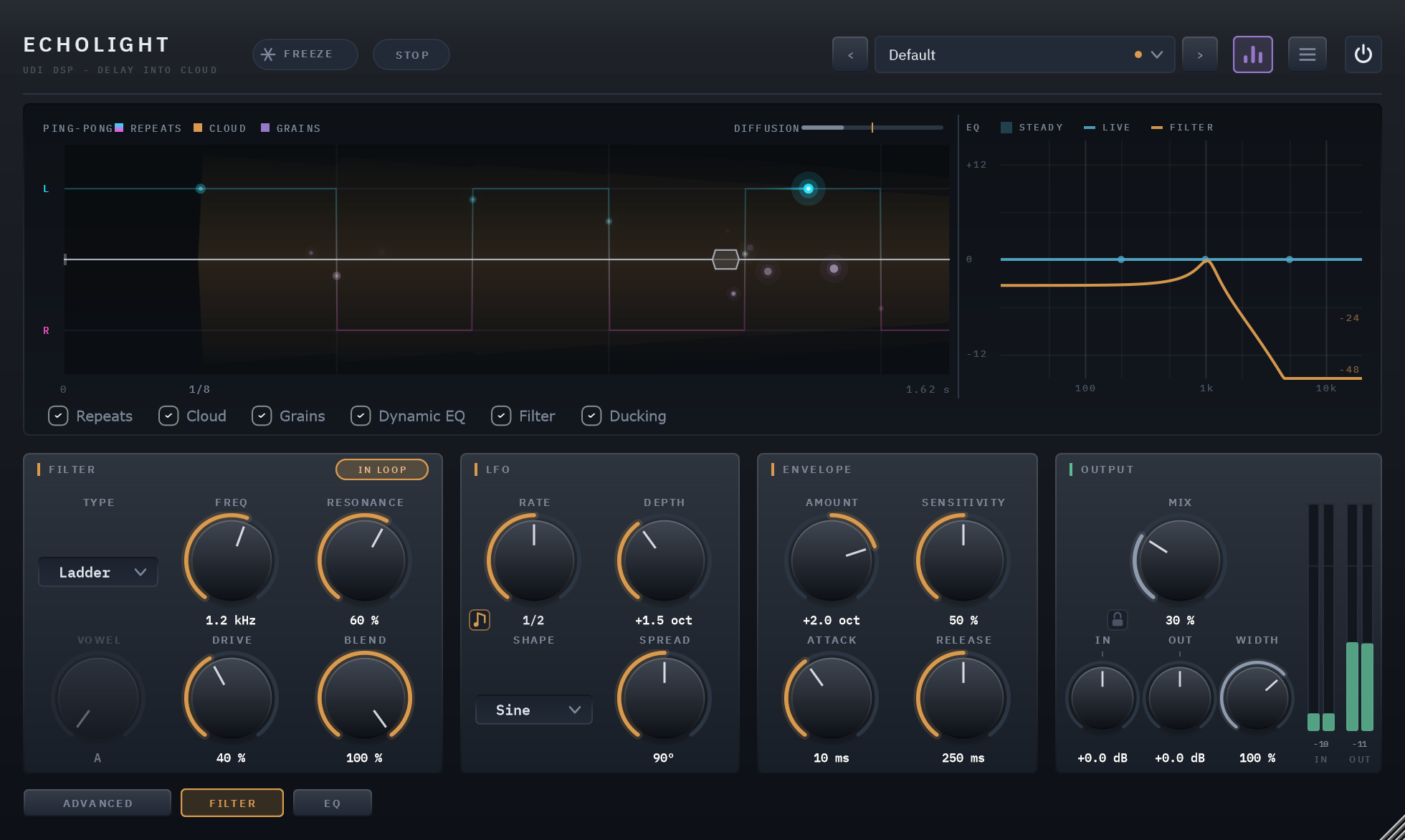
Open the Filter page from the footer and choose a Type: Low-Pass, High-Pass, Band-Pass and Notch; a Comb pitched at Freq that rings as Resonance rises and becomes a flanger when it moves; a Formant filter that makes the echoes speak A, E, I, O and U; or a four-pole Ladder with Drive. Changing type crossfades, and at Off the filter is not there at all.
A pill in the page's title row decides where it sits. After Loop, it filters everything the echoes became, the repeats, the cloud and the grains, once. In Loop, it sits inside the delay, so the first repeat is filtered once and every repeat after it again: a low-pass darkens each echo further than the last, a band-pass narrows them toward a ringing tone. In the loop it never lifts any frequency, however high Resonance goes, so the echoes can never run away.
Beside it, an LFO on Time's feel-and-rate knob, locked to the song while it plays, and an envelope that follows your playing. The display draws the filter's curve in amber beside the EQ's, moving as you hear it.
Specifics, stated plainly
| Engine | A two-line stereo delay (Direct, Ping-Pong and Orbit) with Tone, Low Cut, Warm, Clipper, Wow and Flutter in the loop; a six-stage diffuser into an 8-line FDN cloud; Ghostlight Pro's granular engine |
|---|---|
| Delay | Up to 30 seconds free, or 1/32 to 8 bars synced, straight, triplet or dotted |
| Filter | Low-pass, high-pass, band-pass, notch, comb, formant and ladder, after the loop or inside it, with a tempo-synced LFO (six shapes) and an envelope |
| Dynamics and EQ | 3-band dynamic EQ (static ±12 dB + reactive), Ducking keyed by the dry input, and two safety ceilings |
| Output | Mix against the dry signal, with a padlock that holds Mix, In and Out through preset changes; Width on the echoes, the cloud and the grains, from mono to 150%, with the mono fold-down unchanged at every setting; In and Out trims, ±24 dB |
| Latency | 0 samples |
| CPU | 1.2% of one core idle, 6.4% worst case — everything maxed, the Filter page included — 48 kHz stereo, 512-sample blocks |
| Parameters and presets | 78 parameters, all automatable; 44 factory presets in seven categories, plus Default |
| Licensing | Free UDI DSP account, one-time online activation — no subscription, works offline for a week between checks |
Compatibility
- VST3, 64-bit — Windows 10/11 (a Standalone app is included in the installer). AU, AAX and macOS are coming soon.
- In active development — full per-host verification across DAWs is ongoing.
- Internet needed once, briefly, to activate (a short browser sign-in) — day-to-day use after that works offline for up to a week between checks.