Dronevoice
Speech in, a monster out. BODY takes a voice down two octaves with its throat following; FORMANT, RAGE, GROWL, LEGION, ECHO and HAUNT make it as big, angry and haunted as the scene needs, and a display shows what the voice is doing.
 On sale
A person goes in. Something else comes out.
Dronevoice turns a spoken line into a creature. Bring BODY down and the voice gets bigger: its pitch and its throat fall together, so it sounds like a larger mouth, not a recording played slowly.
Then add as much anger, as many voices and as much haunting as the scene needs, with a handful of controls and a display that shows what the voice is doing. It is for sound designers, trailers, games, podcasts and anyone putting a creature on top of a line of dialogue.
The same clip, dry and wet
8 sources, each run through the factory preset built for it. Toggle Dry/Wet mid-playback — it crossfades from the same instant rather than restarting.
Size you can hear in the throat
BODY takes the voice down two octaves or up one, and its throat goes with it. FORMANT moves the throat on its own: a low voice with a small throat is a different creature from the same pitch with a big one.
How big, how angry, how haunted
Eighteen knobs and a switch for REVERSE. BODY and FORMANT: how big. RAGE and GROWL: how angry. ECHO and HAUNT: how haunted. LEGION and MONOTONE: how many, and how fixed.
The "s" gets tamed
Pitch a voice down and its "s" and "sh" stand out from the word. SIBILANCE tames them as BODY falls and touches only unpitched sound, so the words keep their body, and the "s" is held out of the space so it does not feed the reverb.
A space with a 30-second tail
HAUNT grows the size, the length and the level of a reverb together, from a hint of room to a tail of about 30 seconds. DUCK steps it aside while the voice speaks and lets it bloom back in the gaps.
Grit that stays clean
RAGE runs from warm saturation to hard clipping at twice the sample rate, always, so it stays clean at the top. GROWL adds a throat rattle, slower the lower BODY goes.
A crowd, or a chant
LEGION brings in up to four more voices, each a little off in pitch and in time, and the level is held as they arrive. MONOTONE pulls the voice toward one note, all the way for a chant.
Echoes that sink
TIME is free milliseconds or locked to the song, 1/32 up to one bar. ECHO FALL drops each repeat by up to 12 semitones, and REVERSE plays the repeats backwards.
Light, and clear about time
About 1.4% of one CPU core at the defaults and almost nothing in digital silence. The latency is fixed at about 78.8 ms (3782 samples at 48 kHz), the same at every setting, told to your host, and kept when you bypass.
20 presets in two groups
Creature and Scene, plus Default. Each is voiced to Default's loudness, within about 1.5 dB, so you compare them by ear and not by volume.
Three monsters to start with
These are places to start, not rules. Take BODY down first, then correct it, then add the rest. Put SIBILANCE up as BODY goes down, and use LEGION on a stereo track.
The ogre
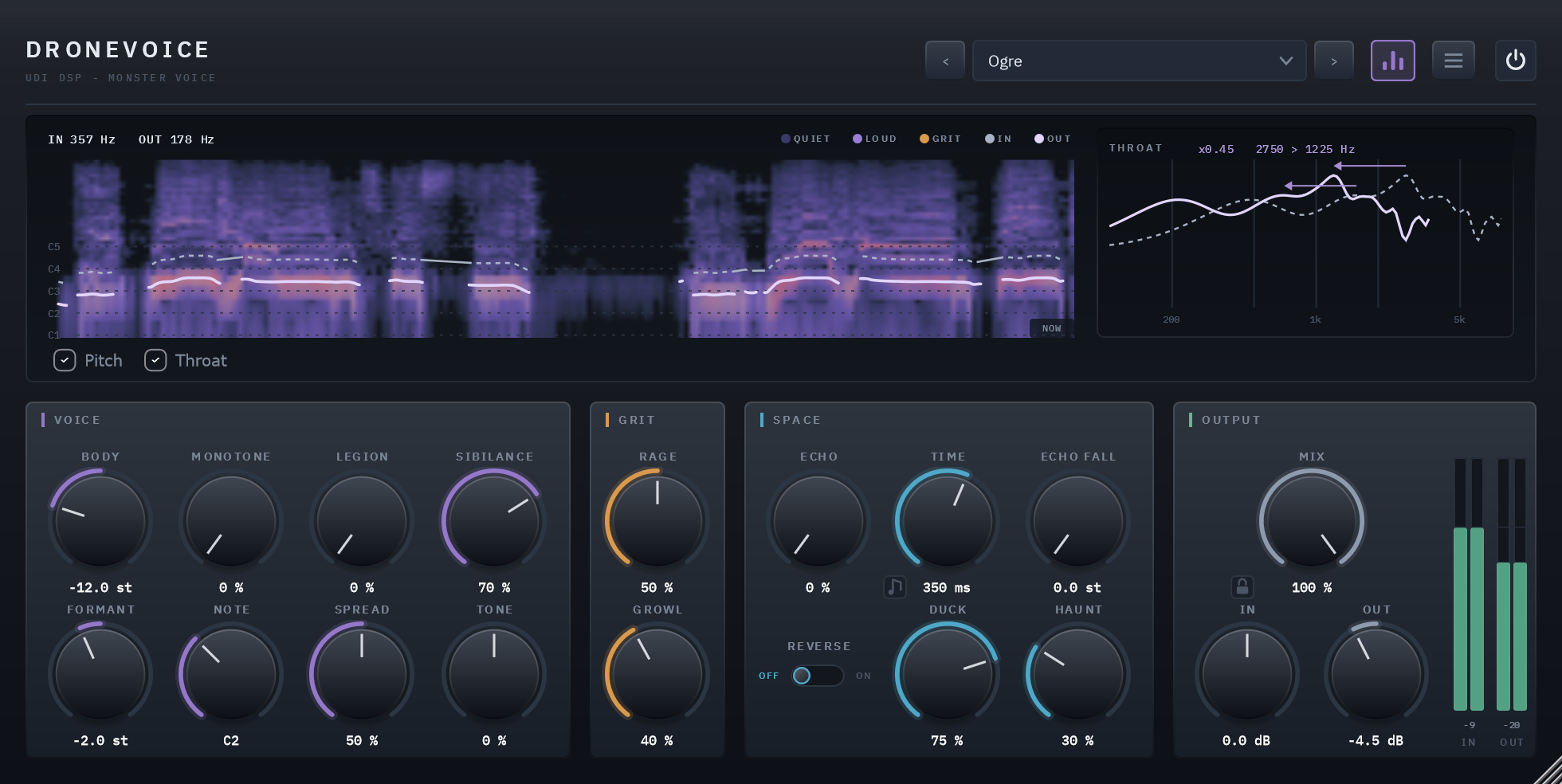
BODY -12 · FORMANT -2 · RAGE 50% · GROWL 40%
A voice an octave down with a bigger throat than its pitch alone would give, some distortion, and a throat rattle. Add SIBILANCE (the factory presets use 70%) so the "s" does not whistle through it.
The whisper in the walls
FORMANT -4 · LEGION 40% · ECHO 30% reversed · HAUNT 80%
Leave the pitch where it is, make the throat bigger, and let a few voices and a backwards echo play in a long, dark space.
The chant
MONOTONE 100% · LEGION 80% · HAUNT 70%
Everyone on one note, many mouths at once, and a space that does not end.
The twenty factory presets in the Creature and Scene groups are starting points in the same way: each sets every control, so you hear it whole and then take it apart.
Start with a bigger mouth
BODY is the whole idea. Bring it down and the voice falls by up to two octaves, with its throat falling with it, so it sounds as if it comes from something larger. Bring it up and the voice gets smaller, by up to an octave, for the imps and the things that live in walls.
FORMANT moves the throat on its own, against the pitch. Bring it down for a bigger throat at the same pitch, up to make the same pitch sound smaller. SIBILANCE tames the sharp "s" and "sh" that stand out as a voice goes down, and TONE tilts the whole voice from dark to bright.
Give it teeth
RAGE is distortion in two halves: the first half saturates, the second clips harder. It sits after the voice stage, so a whole crowd of voices is distorted as one body, and the display glows where it bites.
GROWL adds a fast, uneven flutter to the voiced parts of the sound, about 55 Hz at BODY 0 and slower as BODY goes down. The "s" and the breath are left alone.
Bring friends, or chant
LEGION brings in up to four more voices around the main one, each a little off in pitch and in time. Turn it up and they arrive one at a time, and the level is held, so you get a crowd and not just a louder voice. SPREAD sets how far they stray, up to the full width of the stereo field.
MONOTONE pulls each pitch of the voice toward the note you choose: a little for a flatter, colder delivery, all the way for a chant on one note. Together they are a cult at midnight.
Let it linger
ECHO brings the voice back, and ECHO FALL lets each repeat sink by up to twelve semitones, so the echoes get deeper as they fade. REVERSE plays the repeats backwards, for the echo that arrives wrong.
HAUNT is a whole space on one knob, from a hint of room to a tail of about 30 seconds. DUCK keeps it out of the words' way while the voice speaks and lets it bloom back in the gaps, so the line stays clear and the dark stays around it.
A display that shows the monster at work
The cloud is the output's spectrum over the last four seconds, brighter where it is louder, and it glows amber to red where RAGE is bending the sound. The pitch layer draws the voice you put in as a dashed line and the creature that comes out as a solid one, with the spread of LEGION's crowd around it.
The throat layer draws the voice's resonances, and where BODY and FORMANT move them, with the strongest one's move marked. Each layer switches off, and the whole display can be hidden, which shrinks the window to the four cards.
Specifics, stated plainly
| Latency | 3782 samples at 48 kHz (78.8 ms), fixed; 3479 at 44.1 kHz, 7510 at 96 kHz. No control moves it |
|---|---|
| Channels | Mono or stereo in, mono or stereo out, and mono in with stereo out. LEGION's width needs a stereo track |
| Voice range | Voices from 65 to 600 Hz (outside that the sound takes the unpitched path); BODY down to -24 semitones, with the throat following to a quarter |
| Output | MIX against the dry voice, kept in time with it, with a padlock that holds MIX, IN and OUT through preset changes; IN and OUT trims of ±24 dB; the processed sound is held under a safety ceiling just below 0 dB |
| Tail | HAUNT up to about 30 seconds. The plug-in tells your host how long the sound will ring, worked out from the settings (0.58 s at the defaults, about 77 s with HAUNT at 100%), so a bounce lets the tail finish |
| CPU | About 1.4% of one core at the defaults, about 4.3% with a creature on (BODY, FORMANT, RAGE, GROWL, HAUNT and SIBILANCE up), 5.2% in the heaviest case measured (every voice, full grit, echo falling and reversed, full reverb), about 0.2% in digital silence; 48 kHz stereo, 512-sample blocks, the panel closed |
| Parameters and presets | 21 parameters; 20 factory presets in two groups, Creature and Scene, plus Default |
Compatibility
Windows
- Operating system Windows
- OS levels Windows 10 or 11, 64-bit
- Plugin formats VST3 and AAX
macOS
- Operating system macOS
- OS levels macOS 11 (Big Sur) or later, on Apple silicon (M1 or later)
- Plugin formats AU, VST3 and AAX
Internet needed once, briefly, to activate (a short browser sign-in). Day-to-day use after that works offline for up to a week between checks.
Validated in Cubase Pro, Avid Pro Tools, Apple Logic Pro, Reaper, Waveform and FL Studio. More information.