Clearlight
A cinematic reverb built around one refusal — it will not trade size for clarity. An early-field stage fills the gap that makes big reverbs swallow a source, so the tank can go huge without the mix disappearing into it.
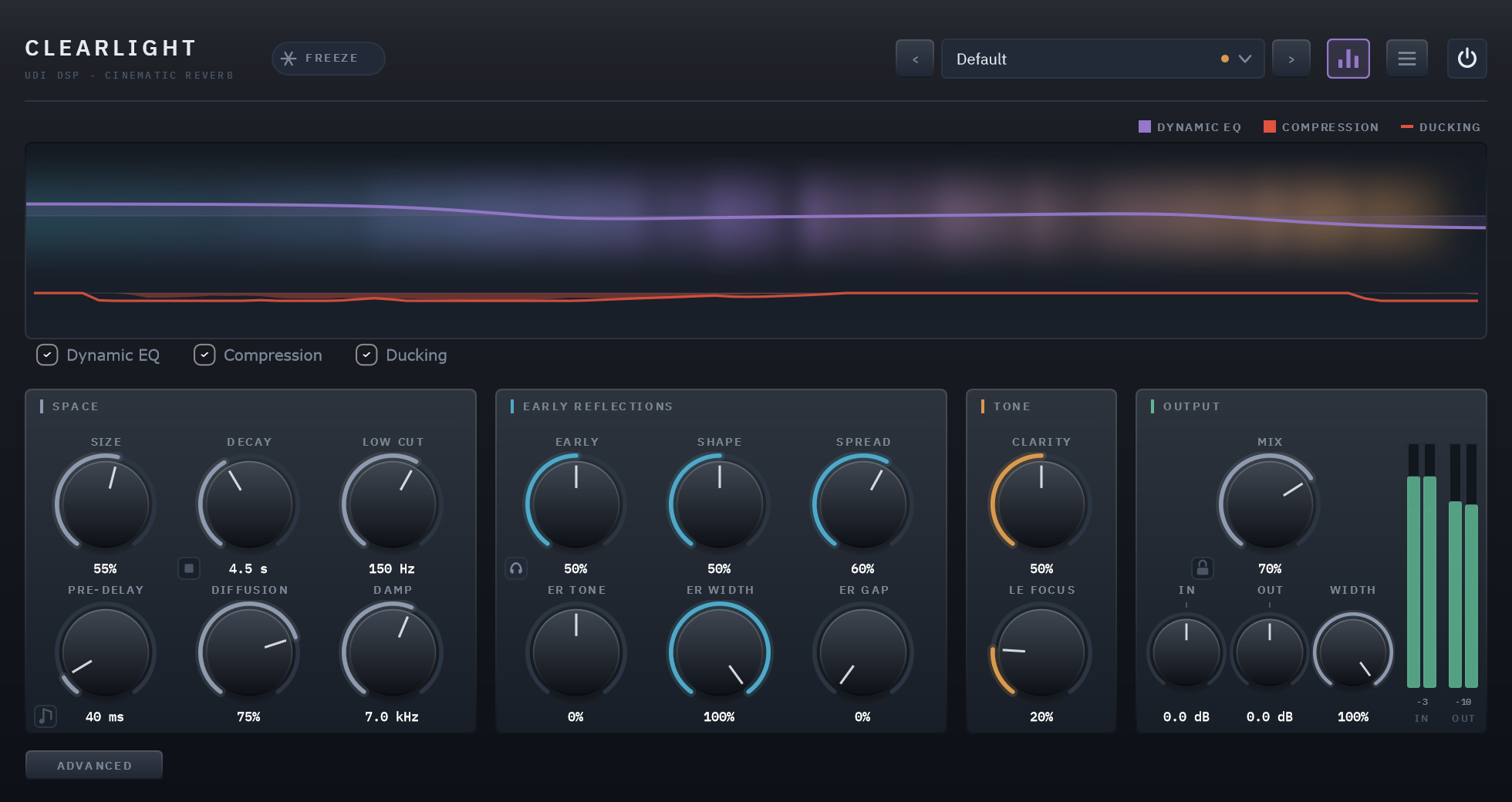
Big and clear, not big or clear
Push a reverb toward huge — long decay, large room, dense diffusion — and most designs start losing the source: consonants blur, transients soften, the mix reads as wash rather than space. Pull back for clarity and the reverb shrinks with it. Clearlight's whole architecture exists to give you both at once.
It sounds huge because the tank underneath — sharing DNA with Ghostlight Pro, UDI DSP's flagship reverb — is a genuinely large, smooth, well-diffused space, with a decay ceiling of 60 seconds. It stays intelligible because of a mechanism most reverbs simply don't have: a dense early-reflections field built specifically to close the gap where a big tank's first echoes normally leave a source stranded.
The same clip, dry and wet
8 sources, each run through the factory preset built for it. Toggle Dry/Wet mid-playback — it crossfades from the same instant rather than restarting.
An early field, not a bolt-on
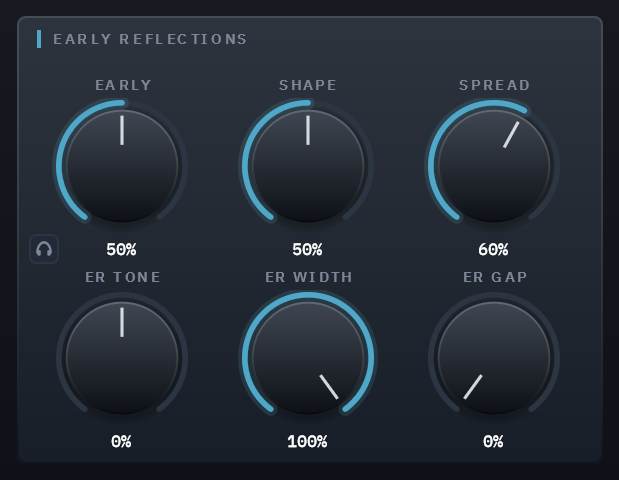
A dense, velvet-noise early-reflections field across the first 20–200ms, fed straight into the tank — closing exactly the window research shows is worst for intelligibility, instead of bolting a switchable ER algorithm on top. Six controls shape it independently of the tail: when it starts (Gap), how long it lasts (Spread), its shape, its level, its colour (Tone) and its stereo width.
Decay up to 60 seconds
Twice Ghostlight Pro's ceiling — tails built for cinematic and sound-design use that a shorter reverb was never built to reach, with the same early-field clarity at every length.
Zero added latency
The early field, the tank and the full dynamics chain all run at 0 samples reported latency. A cinematic-scale reverb that never nudges your timing.
A dynamic EQ on the tail
Three bands — low shelf, bell, high shelf — each with a fixed Static setting and a level-reactive Dynamic amount that follows the wet tail, plus movable Frequency and Q. Bit-transparent until you move it.
Compression — glue for the tail
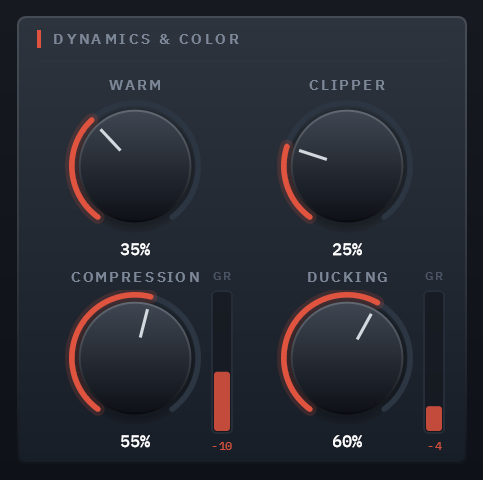
A bus-style compressor on the finished wet signal, with its own gain-reduction meter beside the knob, settles a busy tail into one coherent body without ever touching the dry source.
Ducking — space that gets out of the way
Dialogue-aware ducking pulls the wet tail down while the source is present and lets it bloom back in the gaps, so a big reverb never buries the very thing it surrounds. Its own meter sits beside the knob.
A stereo image that stays solid
Width narrows the tail the usual way; Focus correlates the low end instead of decorrelating it, so a wide tail never loses its center in the bass.
Warm — even-harmonic, by design
A symmetric waveshaper can only make odd harmonics, the edgy kind. Warm generates the second explicitly, so the even ones dominate — measured, 16 dB above the third — with a 300 Hz lift for body. Anti-aliased, zero added latency. Recolors without announcing itself.
Clipper — a safeguard you can't hear, and a drive you can
Bit-transparent below its threshold, so it costs nothing until the signal approaches full scale — then it guarantees no overs. Turned up it's the odd-harmonic drive control, the deliberate opposite of Warm.
Why big reverbs usually cost you clarity
Reverb research points at something most designs quietly ignore: it isn't how much reverb you add that hurts intelligibility, it's when its energy arrives. The first 50–160 milliseconds after a sound starts is, in the research literature's own words, close to the worst possible time to get energy from an intelligibility standpoint — if that energy arrives as a handful of loud, discrete reflections rather than a smooth build. That's exactly what a large feedback-delay-network tank naturally produces on its own: make the room big enough and the first echoes don't arrive for 90–200ms, and they arrive sparse rather than dense.
Clearlight's early-field stage sits in front of the tank specifically to close that gap — a dense, velvet-noise scattering pattern across the first 20–200ms, built at two scales so it reads as a cluster rather than a click. It feeds the tank and is heard directly, so Shape, Spread and Early aren't picking a different reverb flavor — they're adjusting how the room announces itself before the huge part opens up. Both Shape and Early are capped below their theoretical maximum: pushed far enough, an audible slapback artifact showed up in testing, and separately, pushing Early toward its extreme trades the tank's long tail for the early field's own smaller, closer character — the opposite of what a big cinematic reverb is for.
Six knobs that shape the room before the tail arrives
EARLY sets how much of the early field you hear against the tank — the direct-to-reverberant balance, and the most audible control on the panel. The little headphone latch beside it solos the early field on its own, so you can hear what you are shaping before balancing it back against the tail.
SHAPE tilts the field in time, from a front-loaded plate through flat to a reverse swell that builds into the tank. SPREAD sets how far it reaches, from a tight cluster to the full 200 ms span. ER GAP is the room’s own distance: it delays the whole early field, and the tank behind it, by up to 200 ms — the pause before the first reflection that the ear reads as the size of the space. Pre-Delay, by contrast, moves the tail relative to the early field, so the two together place the walls and the room separately.
ER TONE is a ±6 dB tilt around 1 kHz on the early field alone, applied after it has fed the tank — so you can hear a close, bright source in front of a large, dark room without changing what the tail is made of. ER WIDTH narrows the early field’s stereo image on its own, from the fully decorrelated default down to mono, for when a wide early field is too much in a dense mix but the tail should stay big.
SHAPE and EARLY are both capped below their theoretical maximum. Pushed past that point a slapback artifact appears in the early field, and — separately, and just as decisive — a high EARLY trades the tank’s long far-field tail for the early field’s own small, close character, which is the opposite of what a cinematic reverb is for.
A display that shows the reverb
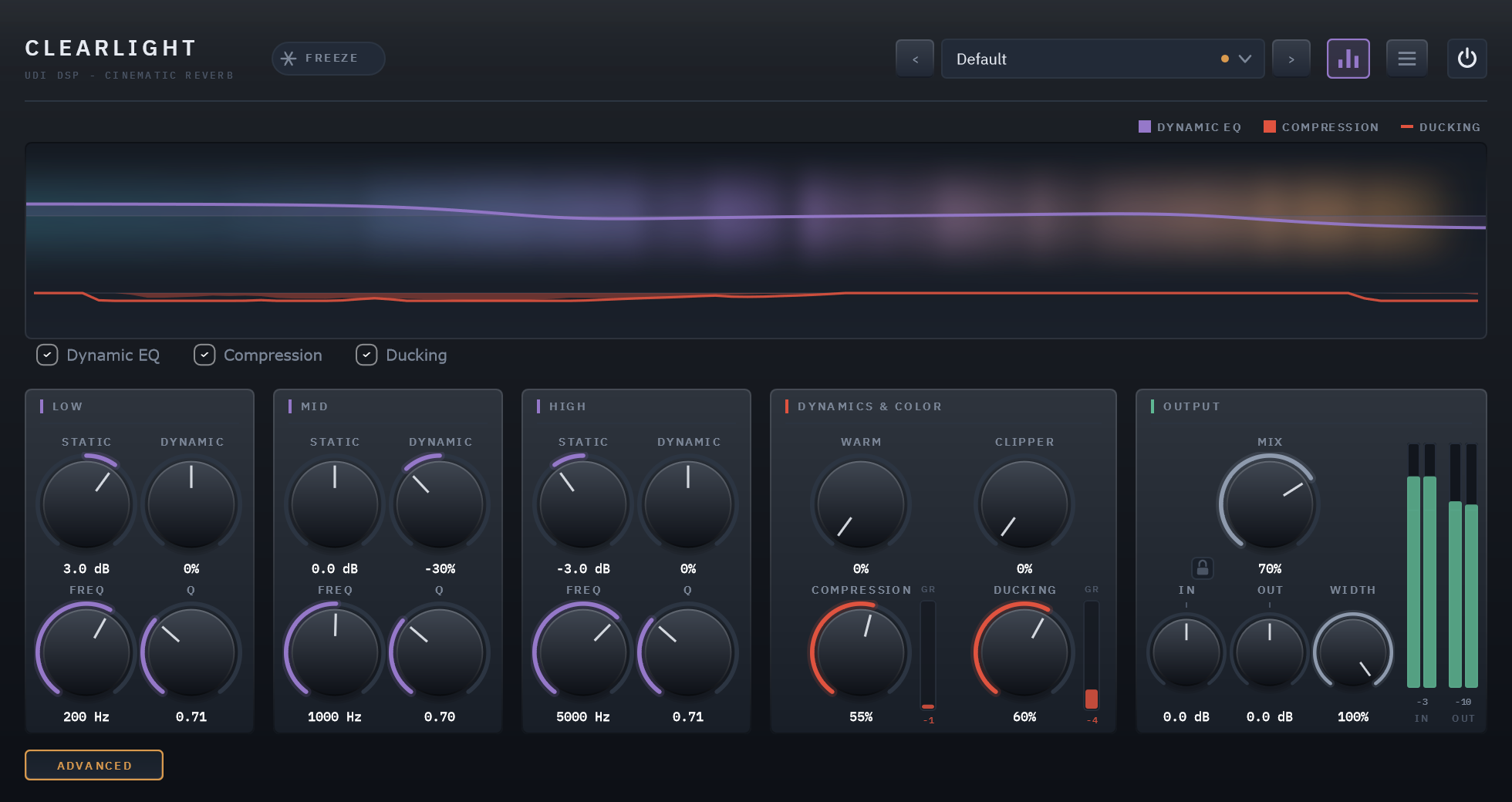
A spectrum cloud shows the wet tail's real, live energy across the spectrum. Over it, a Dynamic EQ overlay draws both the static shelf shape and the actual reacting curve as two distinct lines — so you can see the moment Dynamic engagement pulls away from the static setting, not just read two numbers.
Below the cloud, a gain-reduction strip traces the last three seconds of Compression and Ducking rather than showing a single instantaneous number — motion is what makes a dynamics processor legible, and a still reading throws exactly that away. Compression is the filled area, Ducking the line on top. A stage you have turned off draws nothing at all, and turning one down lets its trace scroll off to the left rather than blink out. A colour legend sits top right, per-layer toggles bottom left, and the whole visualizer collapses from the header button when you want the panel shorter.
Sixteen more controls, out of the way until you want them
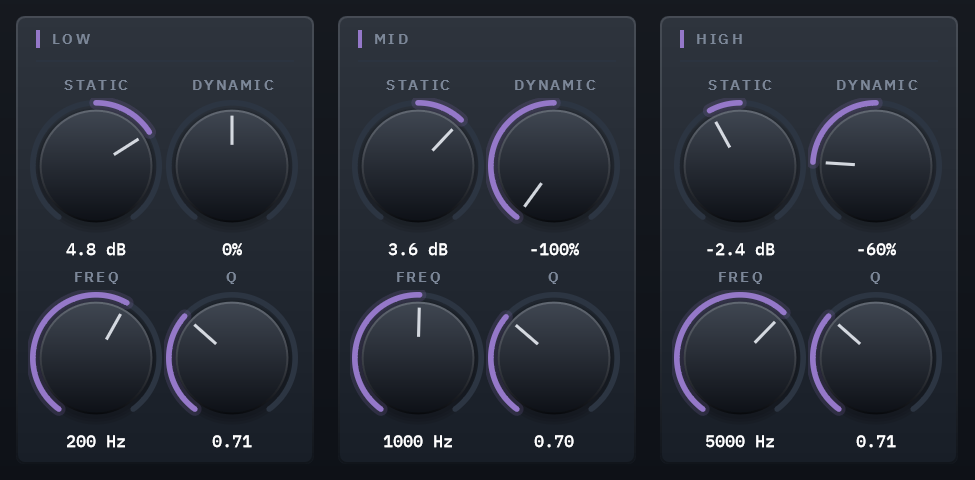
The button at the bottom left swaps the three main sections for sixteen detail controls: a Dynamic EQ on the wet tail — Low, Mid and High, each its own section with Static, Dynamic, Freq and Q — and four colour and dynamics stages: Warm, Clipper, Compression and Ducking. Every one of them defaults to off or neutral, so you never need to open it, and OUTPUT stays put either way, so you keep your levels and meters while you work.
The Dynamic EQ: three bands on the tail, not on your source
It sits on the wet signal only, so nothing it does can dull the dry source in front of the reverb. Low is a shelf, Mid a bell, High a shelf, and each is a section of its own with four knobs. With Static at 0 dB and Dynamic at 0%, the three bands sum back to exactly the signal they were given — bit-transparent, not nearly — so the section costs nothing until you move it.
Freq places each band: Low 20 Hz–1 kHz, Mid 200 Hz–8 kHz, High 1.5–16 kHz, so Low can mean 60 Hz under a kick tail or 400 Hz in a boxy room. Q runs 0.30 to 4.00 — wide enough to shape a whole region, tight enough to reach one resonance.
Static — the tone the tail keeps
Static is the ordinary EQ move: a plain ±12 dB on that band, always on, the same whether the tail is roaring or nearly gone. It sets the tone the reverb keeps — a little weight under a vocal chamber, a few dB off the top of a bright plate, 300 Hz out of a room that booms.
It is deliberately a shaping range rather than a mixing one. Because the three bands recombine exactly, moving all three the same way is a plain level change, which is the one thing a tail EQ should not become.
Dynamic — the same band, reacting to what the tail is doing
Dynamic is the half that moves. Each band watches its own level in the wet tail through an envelope follower — 5 ms to react, 150 ms to let go — and applies gain only while that band is above a threshold. Quiet passages keep the tone Static set; loud ones get the correction.
It is bipolar, and the sign is the whole control. Turned down, the band ducks itself when it gets loud: low-mid build-up on a big hall, sibilance sprayed into a long tail, a room note that only rings on the loudest chords. Turned up, the band lifts when it crosses the threshold instead — air that arrives only on the loud strokes, weight that blooms on a hit and stays out of a quiet phrase.
One knob per band carries the whole detector. Its magnitude sets threshold and ratio together, from a gentle −6 dB at 1:1 to a firm −30 dB at 4:1, so you dial how much reaction you want rather than balancing numbers. Static and Dynamic stack: a band can rest at +3 dB and still pull 6 dB below that on the loudest notes. Boosts are capped at +15 dB combined, so no pairing of the two can run away into the Clipper.
The visualizer draws both at once — the translucent fill is the static shape, the solid line is what the bands are doing right now. When the line pulls away from the fill, that is Dynamic working: here, Mid at −100% pulling the mids down as a vocal phrase peaks.

Warm — even harmonics, not edge
A symmetric waveshaper can only make odd harmonics, the hard kind. Warm generates the second explicitly so the even ones lead — measured 16 dB above the third — with about 2 dB of lift around 300 Hz for body and a gentle tape-style rounding above 12 kHz. It is anti-aliased by construction rather than by oversampling, so it adds no latency, and it recolours a tail without announcing itself.
Clipper — a ceiling you can't hear, and a drive you can
Clipper is the one stage always in circuit, because a safety net that is switched off is not one. Below its knee it passes the signal through bit for bit, so at rest it costs nothing; above the knee the curve bends to a hard ceiling that no setting here, and no amount of EQ boost upstream, can push through.
Turned up it becomes the colour opposite of Warm: odd harmonics, and no makeup gain, so the drive you add is drive you hear. The first half of the knob stays close to clean and the character gathers in the top third.
Compression — glue for the tail
A linked-stereo bus compressor on the finished wet signal, never on the dry. One knob opens threshold and ratio together, from a light touch down to −40 dB at 8:1, with a 15 ms attack, a 200 ms release and a soft knee. It settles a busy tail into one body rather than a pile of separate decays.
Makeup is genuinely automatic: two slow level trackers compare what goes in with what comes out and apply the difference, so the knob changes density rather than loudness. A gain-reduction meter sits beside it, and the visualizer traces the last three seconds as a filled area.
Ducking — a big reverb that gets out of the way
Ducking listens to the dry source rather than the tail, and pulls the wet down while the source is playing — up to 12 dB — then lets it swell back in the gaps. A 10 ms attack clears the first syllable; a deliberately long 600 ms release stops the tail popping up between words and lets it bloom at the end of a phrase instead.
This is the control that makes a twenty-second tail usable under dialogue or a lead vocal: the space is fully there, but only in the moments nothing else needs the room. Its own meter sits beside the knob, and the visualizer draws it as the line above Compression’s fill.
Specifics, stated plainly
| Engine | 8-line FDN (shared core with Ghostlight Pro), plus a dedicated early-field stage — velvet-noise scattering at two scales, feeding the tank and the wet bus directly, with its own independent gap, tone and stereo width |
|---|---|
| Decay | 0.3–60 seconds, with a stop button that empties the tail at once; optionally on every preset change |
| Output | Mix against the dry signal, with a padlock that holds Mix, In and Out through preset changes; In and Out trims, ±24 dB; Width on the tail, from mono to 100% |
| Dynamics chain | 3-band Dynamic EQ (static ±12dB + reactive, movable Freq and Q per band), Compression, Ducking, Clipper (always-on safety ceiling) |
| Latency | 0 samples |
| CPU | 7.03% idle, 8.61% worst case — everything maxed — one core, 48 kHz stereo |
| Licensing | Free UDI DSP account, one-time online activation — no subscription, works offline for a week between checks |
| Footprint | Lightweight binary, zero background services or daemons |
Compatibility
- VST3, 64-bit — Windows 10/11 (a Standalone app is included in the installer). AU, AAX and macOS are coming soon.
- In active development — full per-host verification across DAWs is ongoing.
- Internet needed once, briefly, to activate (a short browser sign-in) — day-to-day use after that works offline for up to a week between checks.